Sunday, December 27, 2009

Endings

"All endings are actually beginnings, we just don't know it at the time." -Mitch Albom

Has it really been three weeks since I finished flight school? Gulp. I can just about imagine how many people actually still read this: it's probably the same number of people who've successfully paid me to fly their airplane so far: zero. I started writing this shortly after I passed my final checkride, and somewhere between driving 3100 miles and having the egg-nogg IV inserted into my forearm, I lost track of the blog. Who knows how much longer I'll keep this up now that my formal training is finished. The important thing is to at least share the conclusion, right?

No matter how long a particular journey is, there's always a myriad of emotions when it's finally over. But is there a certain way one should feel? Whatever the manual says, I don't think I followed it properly: there were no victory parades, no celebratory champagne toasts, and not even the obligatory trip to the Chinese buffet. I'm still not sure what happened. Did I really do this? Is it actually over? It still doesn't seem real: I'm still waiting for the FAA to storm my house in the middle of the night William Wallace-style, take all my pilot certificates, then set everything ablaze on their way out. But it really is over. Hard to believe. Look, I hate cliches as much the sandwich artists at Subway hate it when I ask for extra spinach, but it really does feel like yesterday I packed up my house and moved to Texas. And now it's over? I feel many things, but above all else, I am relieved. I'm glad that my sixteen hour study days are over, and happy that the late night sim sessions are through. Grateful that I survived the grueling pace, and thankful I made it my original goal: I'm now a certified flight instructor with 220 hours in the logbook. I scraped and clawed for every single one of those hours, and could have compiled some awfully disgusting statistics about if I'd kept track. I'm excited that I'll now have the freedom to decompose on my parent's couch while not feeling too guilty about not studying.

It took way too long for my body to detox from eating nothing besides sandwiches and noodles. For the first few days I kept reaching instinctively for sandwiches, even while Mom did everything short of strapping me to a chair and pouring pureed steak and chicken down my throat. The good news: I survived without contracting any communicable diseases and while keeping my sanity intact. The bad news: I lost an inordinate amount of weight and successfully convinced my stomach that the food pyramid is nothing but an elaborate hoax. I'm sure I'll develop some form of mutation later in life because of this.

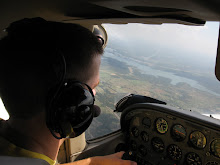
My last checkride was largely uneventful. Back in the single engine Cessna for the last time, I took this one out of the right seat, and played the role of flight instructor. The examiner was cheerful and full of conversation, almost exceedingly kind, like he knew just how hard I'd pushed myself to get to that point. I flew a variety of maneuvers, mostly ones I'd performed before, talking through each as though I were teaching a new student. It was almost easy. On my final approach to Arlington, some 400 feet above ground, a fuel track inadvertantly drove out on the runway, parked itself, and forced me to make an emergency go-around. The odds of this happening had to be something like 227,000 to 1. I mean, my roommate and I had wasted hundreds of hours practicing this exact scenario, only because we both loved throwing unmitigated disasters at one another to see how we'd react. But who, besides terrorists, drives a fuel truck on an active runway? As I jammed the throttle forward and began to climb, I called the control tower to notify them of what was happening, and in a matter of seconds, chaos ensued. Controllers could be heard over the frequency yelling at one another, wondering how such a colossal breakdown in airport security could occur. Phone calls were made, and the words 'FBI' and 'arrests' were audible over the radios. Either way, I was soon out of the traffic pattern, and planning for the return landing. In a matter of moments, I was back on the ground, and I had passed my final checkride. As for the fuel truck guy, I think it's safe to say he didn't pass his checkride.

For the last time, the examiner shook my hand and forked over my temporary certificate. I think even someone as experienced and proficient in the airplane as he is can appreciate just how far I've come in five months. Or maybe he was lamenting the fact that I'd no longer be making trips to the ATM for the express purpose of bolstering his bank account. Did I really give the examiner $3,675? Yes. Hopefully he's enjoying that two week yacthing expedition off the Caribbean islands. You're welcome, sir. I'd prefer to not think about that money.

Thank you for reading this journey, for following along as I struggled first with a new environment and grasping the intricacies of flying an airplane, for growing with me as I flew by myself for the first time, to encouraging me during the instrument phase, for listening as I wondered if I'd ever make it, and for putting up with a ridiculous sandwich count at the end of every posting, all the way to seeing and hearing about the finished product. In a way, you are all pilots too. I may be leaving flight school, but I'll still be blogging, and since I'm writing this retroactively, there's a new journey already happening that I'm anxious to write about. In the meantime, here's a short clip from one of my favorite movies that sums up the last 5 months better than anything else I could have said:


Sunday, December 20, 2009

CFI School, Part II

As the long days of instructor school turned into weeks, our collective resolve gradually began to diminish: the TV, which had been neglected for most of the first 10+ days, now found its way back into the routine. The ocean beaches, which we stared after lustily at first, soon became too enticing to pass up. And the piles of textbooks, which had ingrained themselves into every fiber of our existence, soon sat in far corners of the condo, longing to be picked up and held again. Combined, this was substantial evidence that either we had offically reached burnout stage, or that we were ready for our checkrides.

The worst part of the first ten days? The uncertainty of not knowing when it would be over. Anyone can withstand pain, torture even, when there is a clear end in sight. Just ask Detroit Lions fans. But when it seemingly will go on forever? That's when hope is lost. Eventually, word was passed down from the higher ups that our checkrides had been scheduled, giving us moderate rejeuvenation to regain our strenuous study pace.

Soon after, I was informed that I had indeed escaped 'The Executioner' for my initial flight instructor checkride and was instead scheduled with a gentleman named Walt, who also happened to be the lead ground school instructor. I couldn't have been happier. My classmates all remarked that I'd hit the lottery, and I agreed. After all, Walt was the 70 year-old grandfather figure who spent years working for the FAA, and now, in retirement, found great joy in helping future generations of pilots achieve their dreams. He purposefully sought out us students, often gathering around during coffee breaks and sharing one of his famous one-liners. He was, in all senses, a walking encyclopedia of aviation knowledge. I'd lost count of the times he'd seen me diligently reviewing his lecture notes or preparing lesson presentations and stopped by to offer his insights. This had to be a good thing, right? Having spent four years accumulating brownie points with my professors in college taught me that one can never have enough goodwill stored up-you never know when it might come in handy.

As I spent the final few days prior to my checkride making sure I'd left no stone unturned, Walt continued to help me fine tune my efforts, combing over my power point slides with the same care he used to guard his beloved Taco Soup recipe. I couldn't believe it: my examiner was actually helping me pass the checkride. He told me to let him know when I wanted to get started, and on a rainy Saturday around 8 AM, we decided to go for it.

Now, up until this point, most of my checkride orals lasted 30-45 minutes, at the most. I knew this would be different. A few of my classmates had taken theirs the day before, with one oral exam lasting 7.5 hours. Did we have to know everything? Apparently, yes. As I gathered my materials and lesson presentations, I made sure to pack my 900+ page book of aviaion law, which, ironically, my examiner Walt wrote 1/3 of.

Checkrides are a funny thing. Pilots who've successfully passed through multiple ones say that they're no big deal. To a beginning pilot though, a checkride felt like life or death. At this stage of the game, I'd become accustomed to the process, wasn't very nervous, and wanted simply to pass this one, gain my instructor's certificate, impress Walt, and go home.

Here's the thing: in the aviation world, the initial flight instructor checkride is, by design, one of the hardest to pass. It's not merely a test of skill and proficiency but also of knowledge, safety, and the ability to teach. I've heard the national average pass rate hovers around 40%. None of that mattered to me; I wanted this one bad. It's sort of like playing cards with my Gramma-at first, she's happy just to be playing, but then, after winning the first few games, she's transformed into a ruthless, win-at-all costs competitor. I'm the same way with these checkrides. It's not enough that I made it through the first five without a bust; I want to pass them all.

It didn't happen. Though I blasted through the 3.5 hour oral with few problems, the flight almost instantly turned into a disaster. Walt took it upon himself to fluster, bewilder, confuse, and intimidate me, and it worked. I lost sight of an airport. I nearly breached a restricted airspace. I botched radio calls. My maneuvers, which had been crisp only the day before, withered like a decaying garden eggplant. During the most crucial hour of my flight training, I fell apart. I had failed my first checkride.

We flew back to the departure airport, and debriefed the flight. He wanted to know what happened; I didn't have an answer. Even chipmunks could have flown better than I did that morning. Just like that, $575 down the drain. It was the most disparaging of all possible outcomes.

A few days later, after I'd cleared my head and regained my confidence, I went out and flew like Red Baron, and earned my flight instructor certificate. After all the hardships I'd endured over the past few weeks, it was more relief than anything else. Soon, I found myself back on a plane, bound for Dallas. Instructor school was finished. Only one more week of flight school.
PB&J Sandwiches Consumed (to date): 167

Wednesday, December 9, 2009

CFI School, Part I

The flight school machine may have taken a four day vacation in honor of some of the greatest Pilgrims I know, but that doesn't mean there hasn't been plenty of material stored up for another blog entry. Since I'm a freshly minted commercial pilot, the next logical step was to earn my flight instructor's certificates. After a quick trip home to Minnesota for some much-needed turkey and family time, I was told to be at the Dallas-Ft. Worth airport a few Sundays ago with all of my textbooks and study materials by 1PM. My training partners and I begrudingly packed our suitcases bound for military boot camp, disguised as certified flight instructor school. We'd heard the horror stories from classes before us: 16 hour study days, impoverished living conditions, brutally indifferent instructors, and a checkride with an examiner nicknamed 'The Executioner'. I prepared myself for the worst.

After two weeks of nothing besides sleep and studying, I can only confirm this: I'm exhausted. Each morning when the alarm clock sounds my body groans in disapproval, rebelling against the grueling pace that I've established. I keep wondering when the end is in sight, when I'll get to take my instructor check ride and fly back to Dallas. In the mean time, life is on hold: calls to my cell phone go unreturned, emails neglected, bills upaid, friendships stranded. Make no mistake: this has been some of the most awful two weeks of my entire life.

Living in hamster-like cages with 3 other students lends itself to madness. Few are the moments when I question not only my sanity but that of those around me. Annoyances fester beneath the skin until one of us erupts like some overwhelmed Kindergarten teacher during Show & Tell gone awry. GET YOUR AIRPLANE FLYING HANDBOOK OFF MY BED! Who will reach their breaking point first? It doesn't matter; we all already have. I want to go home, and I'm not even sure what that means anymore. Texas? Minnesota? I just know it's not here.

How much longer can I take it? Who knows. In the meantime, a few stories, good and bad, from the epicenter of it all:

-Delayed in Dallas for over an hour, we sprinted to make our connecting flight in Charlotte, only to have our bags left behind. Faced with the prospect of sleeping without my packed sheets and blankets, I scavanged around the unfurnished townhouse and only found a thin, shredded-up Pocahontas beach towel. Sleeping without any blankets is awful. What did I use to keep warm that first night? Let's just say that I can now paint with all the colors of the wind.

-With no time to go to the grocery store before our first day of class, I splurged and went to Subway with a few of the others in the class. One girl came along, but didn't buy anything, instead plowing some donated crackers with the intensity of a squirrel hoarding acorns before winter. When asked what she had against $5 footlongs, she replied that she only had $3 to her name. $3? No credit cards, no parental assistance, no war bonds she could cash? Nope. I was incredulous. If you're ever wondering why pilots are arrogant, it's because of what they've overcome to get where they are. I'll bet you an oven-roasted chicken breast on Honey Oat that she will never forget how poor she once was, if that airline dream of ours ever comes true.

-One of my first flights here was a required 'Spin Training and Recovery' flight. In layman's terms, a spin is the result of an uncoordinated stall, resulting in the airplane plummeting to the ground as it faces nose-down and rotates around its center axis. In other words, something I don't want to ever happen as a flight instructor. We are required by aviation law to learn proper recovery technique and procedure before earning our instructor's certificates. This was by far one of my favorite flights. The sight picture was a little scary at first, but after I developed proficiency it became a game to see how quickly I could recover. Good to know I'll be able to survive the types of disasters my future students might put me in, just like my instructors overcame my ineptitude just a few months ago.

-Being a native of Minnesota has taught me a few things about winter; namely, that people should not leave the house from Thanksgiving to St. Patrick's Day, just to be safe. The one redeeming quality of being lampooned here in Jacksonville is that I'm able to parade around in shorts and a polo while the locals bundle up with fur coats and scarves. If you need to find me, just look for the guy embracing 55 degree weather by going for late night jogging excursions.

Back to the present: to repeat the mantra I learned very early on in flight school, I'm taking this one day at a time. It's a struggle, especially as I begin to wonder if I'll be finished up by Christmas, but I'm a pilot, and therefore I'll figure things out.
PB&J Sandwiches Consumed (to date): 162

Wednesday, November 25, 2009

Will Fly For Food

I like to cook. Unusual hobby, sure, but it's healthier than constantly eating greasy burritos from Taco Bell 24/7, and it saves money. Unfortunately, the flight school diet has consisted of far too many sandwiches and oatmeal over the past few months, but on occasion I splurge and head for the bulk meats section of the nearest Wal-Mart supercenter, all in hopes of stockpiling the ground beef for making Hamburger Helper. If you have the discipline to ration the portions refugee-style, one can usually get 2-3 meals out of this. Even though I'm now very proficient in making this meal, it always baffles me how it's able to come together. At first it's just a lump of red, raw meat. Fifteen minutes later it's an unrecognizable scramble. Douse it with a few cups of water. Maybe add in some milk, throw a few noodles in it. By now it's all I can do to keep my creation from overflowing the pan and causing a big mess. There's nothing about it that resembles a meal, not even close. It's at this point I mix in the seasoning sauce, and that only furthers the perception that I'm cooking vomit. The discolored blob of ingredients hardly looks edible. But soon, after a few stirs, and enough time over the hot stove, the liquids settle in, the noodles begin to cook, and the pan starts to become one. An aroma flows through the air. Soon, with a little care and effort, my dinner's ready. Now, no one here would argue that Hamburger Helper is a gourmet meal. Point conceded. But there is something special about taking something ordinary and seeing it come to its full potential. Maybe it tastes better because I went through the effort of making it. Or maybe I've gone senile over the past few months and somehow decided that writing a paragraph on Hamburger Helper was a good idea.

No matter, I can't help but draw parallels from one of my favorite low-budget meals and my experiences here. One of my first recollections about this crazy journey comes from back in early May, when the first crate of aviation textbooks and supplies arrived at my house. As I sifted through the boxes, feelings of being overwhelmed consumed me. The materials were things I'd never seen before, never knew they existed. I flipped through a few pages of a training manual and thought, "What did I get myself into this time?" It was a disaster.

Over the next few weeks, little by little, I threw myself into the books. My free time was spent learning things that, even just a few months prior, never envisioned myself caring to learn. And as summer approached, and my flight school date grew ever closer, I realized there was no going back. The beef was now brown.

My arrival here in Texas was met with more books, more uncertainty, and an even greater overwhelming feeling. I remember my first night here: exhausted from the fourteen-hour drive, hungry and in dire need of a shower, I met a few of my training partners and collapsed onto my bed, wondering if I'd made the right decision. The life I'd left behind suddenly seemed remarkably appealing. Was it too late to change my mind? As I stared at the heaping pile of books and aeronautical charts on the table, I wondered how I would ever make it.

The next morning, while eating the first of the PB&J sandwiches for breakfast, I pored over the syllabus, which outlined the next 150 days of my life, almost down to the hour. I'm the type of person who likes to take things one day at a time. I thought I'd accidently stepped into a military prison camp. I felt more out of place than Captain Crunch at a quilting convention. That night my classmates and I studied until midnight. If the first day didn't kill me, I thought, maybe there's a chance I can do this.


Eventually, my classmates and I fell into a routine: wake up, study, go flying, study, sleep. And that's how it went for me for the first month. Before I could blink, I'd been here a month. The reality that I was chasing a dream sprung me out of bed each morning. Soon, after about six weeks, I'd earned my private pilot's license. A few weeks later, I'd added a multi-engine rating. Who knew I had it in me?


Slowly, but steadily, I progressed though the grueling instrument stage. If there were ever a time to quit, this would have been it. These were long days, often starting before 6 and ending well after midnight. I wanted to kill my instructor. He probably wanted to kill me. If Vegas had been taking bets on survival, odds would have been pretty much even.


Time has been on fast forward ever since. I spent two weeks flying around the country, building my hours. I took three written exams in seven days. Just last week, I conquered two commercial checkrides in one weekend, making me qualified to fly for hire. Somehow, someway, the ingredients all came together. I am now a real-live pilot. The end is near. In a few short hours, I'll board a U.S. Airways flight for Jacksonville to begin certified flight instructor school. Two weeks of grueling study and preparation for a checkride that determines my immediate flying future. After being separated for most of the past three months, my classmates from our private pilot days are joining me for this final push. If all goes well, I'll be back to Dallas and done with the program in three weeks. The end is near.


In one of my very first posts, I broke down my ambitions as plainly as possible: I just want to fly airplanes. While I've attained that goal, I'm ready for the next challenge: I want to teach people how to fly airplanes. I'm still not quite sure how this happened, but I never want to go back.
PB&J Sandwiches Consumed (to date): 143

Sunday, November 15, 2009

Break In The Action

They say no man is an island, but flight school can sure make you feel like it. Inhabiting the basement floor often leaves me wondering if indeed the rapture has happened and I've somehow been forgotten. These are dark and quiet days, with few demands on my schedule besides a few hours of flying each day. While it's a nice respite from the grueling pace of the program, the abundant downtime leaves one with a prevailing feeling of guilt. Even tasks once viewed as a productive expenditure of time, like laundry or composing emails, now offer a chance for my conscious to challenge my diligence. You should be studying or getting ahead right now. That's what living each day on flight school autopilot will do. After all, since I first stepped foot on the tarmac way back in July, I've been bludgeoned repeatedly with one assignment, project, or test to prepare for. And now, at least until I leave for instructor school, the exams are finished and ground lessons done, giving me ample time to realize I'm not accustomed to having ample time.

Fortunately, I've combated this by purposefully scheduling early morning flights back in the Cessna and plenty of textbook review. Simply staying on guard against complacency consumes a tremendous amount of energy, especially without an individually assigned instructor for this phase of my program. There are positives and negatives to this, with the major advantage being I get to see and hear several different critiques of my performance in a relatively short period. The major downside, of course, is that I usually end up being tossed around like one of the Kardashian sisters. Since every instructor is different, each has their own idiosyncrasies that can't help but be encountered during a lesson. A checklist flow method that generates applause from one instructor might result in a tongue-lashing from another. Trying to keep them all straight almost requires the use of Microsoft Excel. Today's flight was spent with the most experienced instructor our school has, a guy with nearly 1,700 hours on his resume and enough confidence to salvage a middle school homecoming dance. His penchant for crazy unusual attitude training notwithstanding, the guy knows his stuff and is an excellent instructor. It's hard not to feel intimidated around the more experienced, battle-tested pilots. I look forward to the day when I'm considered a peer, rather than just another student climbing the ladder that seemingly lacks a top step.

A quick glance at my logbook says the 200 hour mark is fast approaching-the minimum benchmark when applying for a commercial pilot's license. Training for the commercial checkride really is a lot less awful than, say, drinking a sewage-flavored smoothie. The new maneuvers aren't all that difficult; it's mostly a refining of the basic skills I learned back in my private pilot days. What's mainly giving me trouble during my training flights is a maneuver responsible for the majority of botched checkrides at this stage, known as a power-off 180. Simply put, it's a simulation of a failed engine while in the traffic pattern of an airport. While parallel to the landing zone, approximately 1,000 feet off the ground, I cut the throttle to idle and begin turning the aircraft back down towards the runway, with the goal to put the wheels of the plane down exactly on a pre-determined spot. Sound easy? The margin for error here is +200 feet, -0 feet. If I land it a foot short, too bad, it's a failure. Also in play: accounting for the wind factor. At no point am I allowed to increase the throttle-my only weapons are adding flaps or performing S-turns while I lose altitude. It is a constant blend of determining position and airspeed while slight adjustments to align the aircraft correctly. To be honest, the few times I've successfully pulled it off so far could be attributed to minor miracle. And even while demonstrating it to me, the instructors repeatedly botch it as well. The moral of the story: hope for a checkride day with zero wind and pray for leniency from the examiner. It's more than that, and with two training flights before the moment of truth I'm sure my proficiency will increase, but it'll be interesting to see how I perform. From this point on, I'm calling it the $400 maneuver. To see it done at a passing level, click here.

There are days I'd love nothing more than to sleep in and lay around, but both of those are incongruent to the ultimate goal and the magnitude of what's at stake here. Seeing the big picture requires loads of discipline, but I'm getting weary. In my downtime I've realized how much I miss family and the structure of normal life. This is the longest I've gone without seeing any of them-4 months. And all the things I miss about my 'normal life', like sleeping in a bed long enough for my 6'4" frame. Morale remains high, and the end is in sight, but man, I am ready for some home cooking. As I finish my final few weeks of training, the sandwiches are rapidly beginning to lose their flavor. Marked on my calendar after this week's checkride: a trip to China World's massive buffet. Motivation for passing never tasted so good.

The other day, a fresh new batch of students came in, all excited and ready to get started with their private pilot program. It strikes me as fascinating that my two classmates and I are now the self-proclaimed big dogs around here, the ones who supposedly know the drill and are viewed as the wise old sages. Let me be the first to say that I feel grossly unprepared for that mantle. What's even more alarming to me is that after Friday of this week, barring a complete disaster up in the air, I will be qualified to begin earning $$$ as a professional pilot. Not that there'll be a Lion King-style stampede of job offers at my door, but still, it's a very exciting and humbling prospect.
PB&J Sandwiches Consumed (to date): 131

Saturday, October 31, 2009

Great Moments In Aviation

One of the greatest ironies currently starring in my life involves the coffee maker in the pilot's lounge. Now, I am not a coffee drinker and probably never will be. (I heard it stunts growth and I still harbor dreams of playing in the NBA) But the peculiarity of policy surrounding the making of coffee simply cannot be ignored any longer. Our flight school trusts us enough to fly $500,000 brand new aircraft all across the United States, completely unsupervised, to airports we've never been to, yet does not think we are capable enough to follow simple instructions from Mr. Coffee. What's unclear is the horrendous chain of events that may have led to this implementation-did an unsuspecting student perform incorrect methodology of brewing? Or maybe there is somehow lawsuit potential if a student scalds himself while making it? Who knows. What I do know is that I'd much rather have the flying privileges sans coffee making responsibility than the inverse of that.


I've just returned from an eleven day cross-country flying tour that was nothing short of incredible. The final numbers: fifty-one hours of piloting time, ten different states, 5,817 miles logged, and a multitude of stories to share. It was, by a long shot, the most enjoyable phase of my training so far. Having taken over 200 photos from the air, I spent an hour or so this afternoon sifting through in search of keepers. If you're interested, click here to view them. For those thirsting for a more detailed description of my adventures, let's go to the envelopes:

The Amelia Earhart Memorial 'Crap, I Think We're Screwed' Award
Easily the most traumatic experience in my young aviation career occurred on the third day, in Jacksonville, FL. One of the most confusing things about aviation is trying to discern appropriate taxiway systems at unfamiliar airports. Even though we were equipped with a folding map diagram of the airport, sometimes things don't always make sense-especially in the heat of the moment. For this particular airport, it was unclear to both myself and the other pilot where the best area to perform a pre-takeoff check would be. Since it was my leg to fly, my partner radioed up to the tower for guidance, but the best the controller had to offer was a muffled response to 'keep going', and we'd 'see one up ahead'. Being perfectly ambiguous, yet still fulfilling his obligations, we really learned nothing from that exchange. As I moved the airplane forward to where I thought I was in the clear, a transmission came over our headsets: 'Turn back and to the right, you've past the run-up area.' As I made efforts to whip the plane back around, my left engine suddenly began to sputter and gradually gave way to nothingness. Just like that, my first engine failure. Now we were in trouble. Frantically, I attempted to restart the engine, but got no response. I took over the radios and told tower we'd need to head back to the ramp due to a blown engine. Unfortunately, I'd never taxied before on one engine, so my rudder pedal skills were pretty shaky. Before I knew it, I'd maneuvered our plane out onto an inactive runway and couldn't get it turned around. With the sweat poring over my face and cascading down the control yoke, I told the tower we might need to come get a tow, as we were quickly running out of wiggle room. Finally, I gave the engine a final chance, and miraculously it started. Pulling a quick 180, I taxied the questionable plane back to maintenance and requested a different aircraft. After a quick phone call to the dispatch attempting to explain my incompetence, we pre-flighted a new aircraft and were on our way-but not before an apologetic phone call was placed to the tower. Despite the inconvenience, I found myself thankful the engine malfunctioned when it did-any later would have constituted a real emergency.

The Octave Chanute 'Man, This Is Way Better Than A Cubicle' Award
This one goes to the leg flown from Jacksonville, FL, to Raleigh, NC. With ample time to plan, my flying partner and I created a route specifically designed to maximize our time spent directly over the coastline. As we soared past prominent cities along the route, snapping pictures at seemingly thirty second intervals, I was reminded of one reason why I am striving so hard to make this pilot thing happen: flying an airplane provides incredible scenery. The photographs probably won't due it justice, but this leg was one great picture after another. At one point, I checked the GPS to estimate how far from shoreline we were. While it was only 10 miles, the feeling over being completely over the ocean is one I won't forget.

The Neil Armstrong 'Hey Buzz, The Field's In Sight, Put It Down' Award
You probably won't believe this, but I was not a crewmember aboard Apollo 11 that landed on the moon. After a night flight with ceilings hovering around 800' at our destination, I can imagine the relief the astronauts must have felt when they finally landed. Coming back from Miami/Ft. Lauderdale last week, we encountered some questionable weather about twenty minutes out: poor visibility, fog, and light rain. Nothing terrible or flight threatening, but enough for us to select a precision ILS approach. In a precision approach, there is a listed decision altitude (DA) listed on the approach plate. Basically, this is a height that you cannot descend below unless certain specific criteria our met. In this case, DA was 1300'. Unfortunately, I was not the pilot flying this particular leg, meaning I was communicating with Air Traffic Control and doing the navigating. As I briefed the approach for my partner, I verbally confirmed with him that our DA was 1300' feet. He responded back, 'OK, 1300' feet, got it.' As the clouds enveloped our aircraft, I glanced at our altimeter, which showed us to be steady at 2000'. No airport in sight yet. We continued to descend, and I watched as we blew through 1600', then 1500', all the way down to 700' feet! My partner had just blown through our minimum altitude, and the airport was not in sight. Now, I've been lucky a few times in my life. The time my buddy Eric and I careened my car off an icy road, did a 720', skidded across the oncoming traffic lane, and buried it in a 4 foot snowbank only inches from the face of a jagged boulder certainly comes to mind. But this was different: I was watching as this unfolded. Calmly, yet forcefully, I announced that we needed to climb, and fast. Thankfully, the plate showed no towers or obstructions in the immediate vicinity. We were only 700' feet above the ground in an unfamiliar area. Just as my partner threw in the power to begin a climb, the airport lights appeared, and he made the decision to continue the approach and land. I've never been so excited to be on the ground as I was after that flight.

The Bessie Coleman 'Hey, These Chili Dogs Are Pretty Good' Award
It's always nice to get free food, in any context, but especially after a three hour flight in cramped quarters on an empty stomach. My vote for best airport goes to Meridian, Mississippi (KMEI), not just because of the massive array of military jets lining the tarmac, but because of the spectacular display of free junk food available to starving pilots like myself. Chili dogs, nacho cheese, an ice cream machine, and mountains of popcorn can cure even the sharpest of hunger pains. Well done, Mississippi, I enjoyed my time there.

The John Glenn 'We're Still Alive' Award
Selfishly, I'm giving myself and my flying partner for the past two weeks an award for surviving and thriving this far into the program. The XC phase was enjoyable, but now I'm ready for the next challenge. With one more rating to attain before the focus shifts to earning my Certified Flight Instructor license, you can bet I'll be putting in extra long hours until the very end. The next thirty days will be an insane sprint to the finish line, starting with commercial training tomorrow, followed by a trip back to Jacksonville for Instructor school. It does seem odd to me that something I've only just begun to do proficiently now enables me to teach other. While it might be a cheesy cliche, I really do feel like I just set foot in Texas last week. In many ways, I still have an inordinate amount of stuff to learn before I can call myself a good pilot. But at the very least, the last two weeks have reinforced my belief in myself, enough to the point that confidence is no longer a problem.

One more note: in our first week of training, way back in July, my instructor recommended a website to serve as a backup to our regular logbook. While it didn't seem like much at the time, I admit now it serves as a fascinating side hobby during my aviation training. One of the best features is a Google map option which shows, by way of red dots, every airport I've landed at. Because you are so keenly interested in this blog, I've posted it here for your enjoyment.
PB&J Sandwiches Consumed (to date): 122

Thursday, October 22, 2009

A New Rating

4:45 AM, Unit #301, ATP Airport Housing Complex
This just in: the only people who should be allowed to be awake at this hour include hobos, fast food employees slogging their way through the night shift, and, on checkride days, pilots. My eyes are still glued shut as I meander towards the refrigerator, where an already-prepared PB&J sandwich serves as my breakfast. As I wolf down the all-to-familiar taste of strawberry jam, Skippy, and wheat bread, I lament briefly on the significance of today and attempt to calm myself before the storm. I am rested and eager to tackle the monumental challenge of proving myself worthy of an instrument rating.

4:57 AM, Unit #301, Kitchen, ATP Airport Housing Complex
All efforts to avoid waking my comatose roommate have been for naught as I unconsciously slam into a pre-arranged pile of dirty Tupperware, cups, eating utensils, and dishes, knocking them 4 feet downward, creating a series of loud crashes and causing him to groan like an agitated walrus. I love checkride days.

5:05 AM, Pilot's Lounge, ATP Housing Complex, ESPN.com
During the NFL season, no day should ever start without the obligatory check of the latest Enjoy Sack Lunch trade news, statistics update, and waiver wire transactions. Even on mornings when my time might be better spent elsewhere. It's only 10 minutes, right?

6:30 AM, Instrument Training Classroom, ATP Training Center
Prior to the examiner's arrival, I spend a quick thirty minutes calculating my takeoff distance, estimated single-engine climb performance, and creating a weight/balance chart for today's flight. To make the numbers fit, I have to intentionally miscalculate my weight at 190. It's the grueling and monotonous kind of paperwork that's necessary to demonstrate that I am a competent planner in any weather condition. The CFI checks over my math and gives the stamp of approval, and now the waiting game begins. It'll be at least an hour before the FAA designated examiner shows up, giving me ample time to review everything I've been studying for the past month. More than anything else, however, this is really just an intense time of heightened anxiety and paranoia.

7:15 AM, Main Offices, ATP Training Center
Like a heavyweight boxer entering the ring, the examiner walks through the front door, briefcase in hand, ready for battle. I would have felt less intimidated if had left behind his executioner's axe, but oh well. My instructor greets him as I retreat out of sight, hoping to avoid his menacing stare for a few moments longer. He grabs my prepared folder of the necessary paperwork, identification forms, and heads to his office alcove to dissect what I've prepared. More waiting, more uneasiness.

7:30 AM, FAA Examiner's Office, ATP Training Center
The absence of a gorgeous nurse notwithstanding, the initial entry to the examiner's office has the exact same feel to visiting a doctor. You wait. You read magazines. Finally, the sound of a door opening is heard, your name is called, and the moment is upon you. Hoping to impress, I shake his hand Adrian Peterson-style, and begin to lay out the required materials: logbook, FAR-AIM, appropriate charts, passport, and, most importantly, four crisp, fresh-off-the-press $100 bills. It never fails: he always makes the standard joke about his wife needing 'to go shopping', but in reality, the sting of handing over such a tangible amount of cash never is easy. He inquiries as to the weather back in International Falls, spends a few moments looking over my records for accuracy, then begins lobbing verbal grenades at me: What are standard alternate minimums? What equipment is required for IFR flight? How do I determine if my aircraft as had the required inspections? When can I descend beyond my Minimum Descent Altitude? With each fastball thrown my way, I grow more relaxed and begin to settle in. A few minutes later, and he's out of ammo. The easy part is over.

8:20 AM, 2,500 feet, Dallas Executive Airport, ILS Approach
The unique aspect to this checkride, when compared the previous ones, is that for the entire duration, I will be wearing foggles, or what's better known as a view limiting device. The examiner will serve as my real life eyes, leaving me to navigate based solely on what the dashboard instrument panel indicates. I'm comforted in the fact that if we slam inadvertently into another aircraft, it'll be entirely his fault. Upon my initial climbout after takeoff, the examiner immediately vectors me east towards a nearby airport and tells me to expect the ILS approach into Runway 31. I know now what's coming, and almost immediately after notifying air traffic control of our plans, he reaches for the left throttle and closes it, simulating a failed engine. The Seminole yaws briefly to the left, but my reactions are swift, and I'm able to stay on the correct glideslope all the way down to minimums. The first hurdle has been cleared.

8:45 AM, 2,500 feet, Cockpit of N6816A
About halfway back from Dallas Executive Airport, the examiner tells me to put my head down, remove my feet from the rudder pedals, and close my eyes: it's time to demonstrate my ability to recover from unusual attitudes. I've done this before, and not just in my aviation career: in 7th grade Art class, my attitude towards ceramic sculpturing was deemed unusual, and I successfully recovered from that by posting a solid C-. As the examiner grabs the yoke and immediately slams the plane forward, my sense of balance and position are immediately thrown off-I have no idea what's going on. His next words to me command action: "Recover!" I have only an instant to determine my next move. Instinctively, I reach for the throttles and scale back to near idle, level my wings, and slowly begin to pitch up. Exhale. I don't think I took a single breath in the last 30 seconds.

8:55 AM, Grand Prairie Municipal Airport, GPS Approach
My hand is firmly grasping the yoke now as my brain tells me to ready for what's coming: at any minute, the examiner is going to cover half of my instrument panel, simulating a real life vacuum pump failure. This was the exact scenario that, a mere three weeks ago, caused me to nearly destroy the flight simulator with a deadly crash. Moreover, the last two instrument rating applicants busted at this precise interval. Today, I negotiate the strong tailwind by reducing throttles drastically, allowing myself more time to focus on the GPS readout. I carefully correct my course to the west, note my position, and make the proper radio calls. Since I've practiced this exact approach countless times in the past week, everything seems like it's in slow motion. When I hit the missed approach point, my hand automatically pushes the throttles full forward while the other applies back pressure, and sooner than I can even think, I'm already through the hardest part of the checkride. The examiner gives me instructions on where he'd like me to enter a holding pattern, and as I brief the hold aloud, I remind myself to stay focused and finish what I've started.

9:20AM, 5 miles from BROUZ, VOR Approach to Arlington Municipal Airport
One of the weirdest things about aviation are the names of GPS waypoints and intersections found on our Low-Altitude En Route charts. While they look bizarre on paper, the are extremely fun to say over the radios. In a different world, I would have been the one to name these points. One can only imagine the logic behind some of the decisions that were made. Apparently the only prerequisite is that each 'place' must have 5 letters and be only marginally coherent. So while I may have never been to the DUMPY, SEXXY, or RDNEK junctions, I have spent plenty of time hanging out near BROUZ. BROUZ is the final approach fix on the VOR approach back into Arlington, and today, it serves as my final potential pitfall for the checkride. Descending even a foot below 2,000 prior to reaching BROUZ means automatic failure. With the two previous approaches and holds behind me, my confidence is like a tidal wave now, and before extending my landing gear and adding flaps, I make a mental note to keep enough power in to keep my altitude. As I clear BROUZ and make my final inbound communication, a feeling of relief sets in: if the examiner hasn't said anything to the contrary by now, I'm the proud owner of an instrument rating. A few seconds later, he tells me to remove me view limiting device, and as my wheels touch down on the runway, I can hardly contain my smile. It's over.

10:00 AM, Pilot's Counge, ATP Housing Complex
Because I was scheduled for the early checkride today, I'm forced to wait until the examiner returns from his 2nd flight of the day. But in reality, this waiting is substantially more pleasurable now that the exam is over. For the first time in several days, I relax on the couch and read non-aviation material. While I'm reasonably certain of the outcome, I decide to hold off on the phone calls until I have the actual instrument rating in hand.

11:45 AM, FAA Examiner's Office, ATP Training Center
The moment of truth. Once again, my name is called, and I knock gently on his door. It's just a formality, but he requests to see my logbook again, and this time endorses his name with the desired 'Satisfactory' label next to his name. It's official: I am an instrument pilot. He hands me my temporary certificate, shakes my hand, and offers congratulations. I'll be seeing him again in three weeks, and believe me, I'm sure he's already looking forward to the $400.

1:45 PM, Unit #301, ATP Housing Complex
The CFI comes ambling into the room to offer congratulations, and for the first time I now feel equal to him. He shares in my pride today, as me passing is a positive reflection on him as well. Knowing he's no longer my instructor is a relief: I've never dealt with as much relentless negativity as he brought to the table, not as a college athlete, not in any of my restaurant jobs, nothing. But I must admit: through it all, he's made me a better pilot. The red-eye simulator sessions, his Stalin-esque standards of preflighting, and the endless assigning of navigation logs have all served a purpose. Motivation comes from many different directions, but for awhile I thank him genuinely for his efforts, patience, and wish him good luck with his next batch of students. For him, the instrument process starts all over with two new students. As I lament the past month, one thing stands out above all: I never once gave up.

The next three weeks are chock-full of flying for me. Starting tomorrow, my training partner and I are unleashed, flying on assignment to pre-determined locations throughout the country. Each morning, we'll call company headquarters in Jacksonville, FL, and receive our flight destination. With no CFI on board, it will be a good litmus test of everything we've learned so far. Designed to simulate airline life, it should be a fun adventure no matter how many times they try to send us to San Angelo. Past students claim this is by far the most enjoyable and rewarding phase of the program. My goal is to build up enough goodwill with dispatch so that they'll trust us enough for a lengthy cross-country trip to Florida. Our first assignment: flying to Houston. I'll try to post as many updates as possible over the next few weeks, including the occasional picture from our trips, so stay tuned.
PB&J Sandwiches Consumed (to date): 112