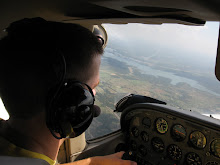
If you had 'Summer 2010' in the When Will Gabe Cease Writing Asanine Blog Posts pool, congratulations, you're today's big winner. I always knew in the back of my mind when I started writing this thing that one day I'd get so busy with other things, namely, flying airplanes, that the blog would the first thing to get neglected. What I didn't realize was just how quickly I'd actually forget I had one. It's true; without the help of a few key readers, we'd actually be attending this blog's funeral today instead of sinking out teeth into another 8-10 paragraphs of nonsense. In many ways, we might have been better off at the cemetery. We're almost 1/3 done with August, and I'm finally getting around to publishing a post I started in mid-June. I don't know how much more a blog can be dead without actually being dead.
For people who still stumble towards this site, it's been some fairly routine time in the air with scant moments of terror or otherwise noteworthy events. I don't really have any great stories from a summer's worth of flying, and since I'm on salary I can no longer provide details of my sandwich consuming escapades. So in fairness to all parties-you, the disgruntled reader, me, the overworked and underpaid fledgling blogger, and of course this kid-let's recap the last few months and crank out another post and stave off the inevitable demise of this blog for at least another month. Everybody wins right? I won't make any promises, but check back in a few weeks and maybe I'll have something else here too.
It's 8:15 A.M. and I have $23,000 in my pocket. Mine? Nope-if it were, I'd already be downing mai tais and basking in the Caribbean sun. The money in question is designated for flight training, given to me from a few students, and ultimately headed to my company, who by some crazy distortion of a job description, has entrusted me to transport said funds to the bank. I'm a pilot, but days like today my Silver Tauras is transformed into one of these babies for the 4 mile drive to Bank of America. It's one of the many duties that hardly pertain to flying airplanes, but yet are essential in order for me to continue cashing paychecks. Other tasks include, but definitely not limited to, emptying trash, mopping floors, scrubbing down sinks, and making sure I don't forget my glass slippers on the way out of the midnight ball.
Even if my life were as simple as just flying airplanes; I'd still be overwhelmingly busy. As I totaled up my logbook last night, I came away with some staggering numbers: in the past four months I've flown 392 hours, more than doubling my time to where it sits today at 730 flight hours. It's been a grueling pace and has taken its toll in ways too numerous to count. I honestly will never know or understand how I've been able to survive it. Countless days have been spent entirely at the airport, often arriving before 7AM and leaving well after midnight, resting in between each flight or ground lesson with barely enough time to eat a meal standing up, on the run, or, in the case of a few days, in the airplane. Any sembalance of a normal existence is long gone from my life; I said a year ago that I all I wanted to do was fly airplanes. Wish granted-it's all I ever do. Plenty of sacrifices have been made, and there's probably an infinite amount that I've yet to make. The good news is that I still absolutely love to fly airplanes. The same joy I felt on my first lesson is still the prevailing factor in why I do what I do. Even on the worst of days, when the temperature probe reads 105 degrees inside the airplane and I'm getting tossed around the air like a ball of Papa John's dough and my student is doing everything he can to try to kill me, there is simply nothing I'd rather be doing than flying airplanes. I still consider myself impossibly lucky to be a pilot.
The bad news is that I've decided I hate writing about flying. It's also possible that I hate writing in general, but mostly I loathe trying to recreate the excitement and drama that comes with having a job as an instructor pilot. It would be far more interesting if I were to mount a video camera on the windshield aimed towards capturing my facial expressions If there's any billionaire television executives among my readership, please email me; we're sitting on a gold mine. Our first episode would feature me rolling my eyes in disgust as I sit through another excrutiatingly painful story about how great of a helicopter pilot my student claims to be while botching a routine maneuver. Later, during our debriefing session on the ground, a computer could record my brainwaves as I drift off towards thoughts of pizza and tacos instead of focusing on teaching him the Federal Aviation Regulations. And finally, as he boats to the other instructors in the office about how great his lesson went, I'll be just a few feet behind, making repeated throat-slash gestures, warning the other pilots NOT to fly with him. This would be entertaining TV.
Please don't get the wrong idea: I am very fortunate to have the job I've got, and I especially enjoy the teaching aspect of it. There are, however, the occassional goons who sign up for our multi-engine training program and come in with a multitude of aviation experience, and thus, believe they are God's chosen gift to aviation. I've learned that it's the arrogant, cocky, and boastful pilots usually require my absolute full attention during their flights, as they prove to be among the weakest in terms of ability. My mantra from Day 1 as a student pilot was to be humble and teachable and soak up as much knowledge as I could from those willing to invest in me. The majority of my trainees are this way and it's a pleasure to bring them along in their aviation journey. But the others...make me almost not want to fly. Almost.
For now, I continue to plow ahead with my head down and focused on my goals. In a few months, I'll hit 1,000 hours, a milestone that most days still seems unbelievably far away. With my multi-engine experience, I should be in a decent position when the regional airlines start hiring again. While I don't want to get my hopes up, there are hints of an impending pilot shortage, talks of industry growth over the next few years, and a surprising optimism surrounding aviation that hasn't been around since well before I started flying. I reflect an awful lot, probably more than I should, but as I make the final rounds at the airport before heading home, emptying the trash and vacuuming the ground school classrooms, my prevailing feeling is just how happy I am to be established on the journey. And regardless of how it all turns out, vindication that I made a great decision.
One more random story from my life, and then we're done:
Sometime in May, we received notice of an upcoming meeting scheduled for early Friday morning. Begrudgingly we gathered at the airport and learned the bad news: our company had decided to close our downtown Atlanta location, meaning us flight instructors turned into professional movers, complete with U-Haul trucks, dollys, and standard issue moving clothes. It was possibly the last thing any of us instructor pilots wanted to do with our Friday. After spending the entire day hauling filing cabinets, desks, and even ferrying airplanes across the city to our newer location out in the suburbs, we were nearly finished as I grabbed two large glass picture frames in each hand, and proceeded to haul them across the hanger. A simple task, right? I reached the 3/4 mark point, and just as I looked down and noticed the sweat dripping down towards my right hand, one of the picture frames slipped from my grasp, and as I shuffled to try and prevent it from shattering on the ground, the other frame split open on my hand, gashing my thumb down the middle, spilling blood all over the freshly painted hangar floor. I was no longer a professional mover-I was now a professional idiot. My disdain for hospitals notwithstanding, I shrugged off the injury as needing only a Bandaid and I'd be good to go. After all I still had a flight to complete that night, and not even amputation would stop me from going. But in just a few minutes, it became clear the injury was more severe than I thought. By now the pool of blood on the floor was accumulating rapidly. Our Chief Pilot ran over and instructed another pilot to load me in his car and head for the ER immediately. What? Six hours later, I emerged victoriously from the Gwinnett County Medical Center, with 9 stitches and a bandage covering my entire right hand. I made my flight that night, but a few weeks later, when the injury hadn't healed properly, I earned a well-deserved week long vacation as my company implemented a forced rest period while the now-infected hand injury cleared up. Now, I've done some awfully crazy things so far in my career as a pilot. I've certainly flown through weather I shouldn't have, and without a doubt have been saved from a mid-air collision or two by mere seconds. Apparently neither of those things are as dangerous as helping your boss move a few boxes around. And so last month, when a few of the other instructors helped somebody move apartments, I was hardly surprised when a company memo surfaced, instructing me to sit this one out.
Tuesday, June 29, 2010

Monday, May 24, 2010
Getting My Reps
So much of life is about reps: The more we do something, the better we become. Think knitting, public speaking, or even juggling chainsaws. I'd like to think that's the idea behind my life right now-fly airplanes as often as possible to become as safe and proficient of a pilot as possible. Most days, this works out fairly well: I wake up, wolf down a few bowls of Golden Crisp, then head to the airport for 12-14 hour duty days. Fly all over the Southeastern U.S., head home, plow through some food, and collapse my exhausted body onto the bed and repeat. Not that I've become some type of flying cyborg, but somewhere between today and four months ago, I lost track of time and realized I don't really do much else besides fly airplanes or talk about flying airplanes. It's a good thing, because I'm accumulating flight time faster than Lindsey Lohan racks up misdemeanors. Around the hangar I've become known as the flight snake-if there's an unscheduled flight, I'm usually the one who willingly takes the trip. The more reps, the better. Right?
That's what I figured last week as I volunteered my services for a trip up to Bowling Green, KY. My student and I waited around for most of the day, hoping a line of thunderstorms southeast of Nashville would dissipate. As one can probably imagine, thunderstorms combine all the greatest possible threats to flying safely, especially in our little multi engine airplane: hail, severe turbulence, intense winds, and the possibility of a lightning strike. The overall rule is to avoid active thunderstorm cells by at least twenty miles, however, it may surprise you that lightning strikes in large jetliners are actually a relatively common occurrence. Although it's not recommended to request this to the pilots next time you fly commercially, if it does happen, expect a loud, explosive type noise and maybe to be jostled in your seat momentarily. Scour the internet for this and you'll find enough reasons to probably never choose to fly again. But the good news is that you will survive. In the meantime, here's your piece of aviation knowledge for today: all aircraft are equipped with static wicks, small, tube like devices attached to the trailing edge of the wings. Since the bulk of an airplane's exterior is composed of aluminum (hint: a very good conductor of electricity), there has to be a way for the charge to flow safely away from the aircraft in the event it is struck. Static wicks allow the safe discharge of the electricity away from the plane. Despite being a device of such small stature, we are not allowed to take off in our aircraft if missing any of our nine static wicks.
Back to my trip up to Kentucky. We waited until just after 6PM, when finally it appeared on radar that there was enough of a gap for us to make the flight. I assisted my student with the preflight preparation, checking especially to make sure our electrical system looked good and running my fingers across each and every static wick. We were good to go. With the help of air traffic control, we picked our way around a few of the cells and made a largely uneventful first leg of the journey.
A quick bite to eat and my student and I were back at the aircraft, prepping for the night return trip. By this time, most of the buildup had concentrated just north of Nashville and was headed east, giving us enough a window to make it back towards Atlanta. And this is where my night got a little interesting.
One of the intricacies of flying, is the various methods used to obtain an IFR clearance from different airports. (IFR stands for instrument flight rules and allows aircraft to penetrate clouds and fly with the radar assistance of air traffic control) At my home base, for example, we simply contact the control tower, who coordinates with Atlanta Approach our departure heading, route, altitude, anything else that may come up. At an 'uncontrolled' field, however, it's a bit different. Pilots have several options, with the best one usually being to dial up a Flight Service Station and obtain a clearance that way. On this night, we spoke with a very green sounding lady in Louisville. Tentative in her delivery, she seemed perplexed as to the directions she was dispensing: "Seminole 1221K is, uh, cleared to the, um, Gwinnett County airport, at, er, BWG, via the Choo-Choo VOR, and, climb to, hmm...let's see, 7,000 and contact, uh, Memphis on 133.85, squawk 1642." Most of the time ATC and the affiliated organizations do an absolutely phenomenal job with every aspect of their responsibilities. However, this was one of the choppiest clearances I'd ever received. Moreover, it was late, I was tired, and the rain was beginning to slap across our windshield. My student had fumbled through copying it down, so I gave a readback over the mic and prepared us for takeoff.
Our departure runway was 21, meaning we were positioned to fly a slightly southwest course. My plan was to continue that heading until we reached a high enough altitude for Memphis Center to pick us up on their radar, usually in the neighborhood of 2,000 feet. At that point, I was expecting them to give us the go ahead to proceed direct to Chattanooga, and then on in to Gwinnett.
A few moments after takeoff, the street lights below us began to disappear. I looked off to my left, and saw nothing but the bright flash of my anti-collision light pulsating against the thick, cumulus clouds that had now enveloped our aircraft. Through the intermittent bursts of light, I could see that the rain was coming down harder. Suddenly, our little airplane caught a huge updraft and we ballooned 1,500 feet in what seemed like a second. My heart pounded as I knew instantly what was happening: we had inadvertently flown into the outer portions of the thunderstorm. Memphis Center, oblivious to our plight, was busy diverting and repositioning aircraft inbound to Nashville. I gave quick thought to turning around, then decided against it. The rain splattered against the windshield with greater force. I gripped my seatbelt, searching for some sort of security. My student, who for the previous few moments was chatting about the trip excitedly, was now decidedly silent. Turbulence tossed us around, jolting the aircraft up and then down again in rapid succession. Back in my private pilot days, this was the type of stuff I'd read about, and vowed to avoid at all costs. But we were in it. I kept a careful eye on the instruments, focusing on indications I prayed would hold true: Airspeed? Good. Altimeter? Fluctuating, but acceptable. Flight attitude? Level. I turned off the anti-collision lights as they were serving little purpose now.
Rain came down implausibly harder. It was as though God was dumping oceans directly atop the airplane. I'd never seen so much water. I gave the engine gauges a once-over, hoping against anything else now would not be the time I'd experience my first engine failure. Complete darkness surrounded us. Each raindrop, multiplied by the thousands, cascaded against the aircraft fuselage, sounding more like gunshots than precipitation. This is what fear in an airplane felt like.
And then, inexplicably, we punched through the final cloud layer. The rain stopped. City lights reappeared. The aircraft steadied out. The loud pelting of rain on aluminum was replaced by the relaxing hum of the propellers. We made it.
A few moments later, a crystal clear radio transmission came through:
Seminole 1221K, Memphis Center....
"Center, 21K, go ahead sir."
21K looks like you guys pierced through a pretty good sized cell there, everything ok?
"Roger, a bit of heavy precip but not much else, 21K" (For whatever reason I always downplay things with ATC.) I should have said, "MAYDAY MAYDAY, we are actually submerged up to our navals in rainwater." That would have been more accurate.
21K glad to hear, just out of curiosity what was your clearance?
As I reached for my clearance sheet, it hit me: the lady up in Louisville hadn't been wrong. I was stupefied as I read back what I'd written down. I had unintentionally vectored myself and my student into the worst weather I've experienced yet. On takeoff I'd continued a 210 heading a few moments too long when, according to the sheet I held in my hands, I should have flown something in the neighborhood of a 170. Those forty degrees ended up being the difference between a nice relaxing night flight and a terrifying learning experience.
I waited for a response from Memphis Center, knowing I had just inadvertently deviated from an IFR clearance in a non-emergency situation. Fortunately, the gentleman came back over the frequency with a calming voice, assuring me there'd be no action against me. He was glad we were ok, and reminded us that in the event of any uncertainty, always request clarification. I thanked him, and he transferred us to the next controller, and that was it.
Reps. I learned something that night, and so did my student. A few hours later, back on the ground just outside of Atlanta, we were both weary but glad to have a story to tell. I'd survived my first thunderstorm and even picked up an extra bit of IFR knowledge along the way.
That's why I love my job: everything I do all adds up to experience. And ultimately, these reps are what's making me better. Experience counts. So while you're not on my airplane yet, one day you will be, and that's why I'm doing everything I can to ensure moments like this happen now and not while you're sitting in the back, relaxing and chowing down on those awful pretzels.
That's what I figured last week as I volunteered my services for a trip up to Bowling Green, KY. My student and I waited around for most of the day, hoping a line of thunderstorms southeast of Nashville would dissipate. As one can probably imagine, thunderstorms combine all the greatest possible threats to flying safely, especially in our little multi engine airplane: hail, severe turbulence, intense winds, and the possibility of a lightning strike. The overall rule is to avoid active thunderstorm cells by at least twenty miles, however, it may surprise you that lightning strikes in large jetliners are actually a relatively common occurrence. Although it's not recommended to request this to the pilots next time you fly commercially, if it does happen, expect a loud, explosive type noise and maybe to be jostled in your seat momentarily. Scour the internet for this and you'll find enough reasons to probably never choose to fly again. But the good news is that you will survive. In the meantime, here's your piece of aviation knowledge for today: all aircraft are equipped with static wicks, small, tube like devices attached to the trailing edge of the wings. Since the bulk of an airplane's exterior is composed of aluminum (hint: a very good conductor of electricity), there has to be a way for the charge to flow safely away from the aircraft in the event it is struck. Static wicks allow the safe discharge of the electricity away from the plane. Despite being a device of such small stature, we are not allowed to take off in our aircraft if missing any of our nine static wicks.
Back to my trip up to Kentucky. We waited until just after 6PM, when finally it appeared on radar that there was enough of a gap for us to make the flight. I assisted my student with the preflight preparation, checking especially to make sure our electrical system looked good and running my fingers across each and every static wick. We were good to go. With the help of air traffic control, we picked our way around a few of the cells and made a largely uneventful first leg of the journey.
A quick bite to eat and my student and I were back at the aircraft, prepping for the night return trip. By this time, most of the buildup had concentrated just north of Nashville and was headed east, giving us enough a window to make it back towards Atlanta. And this is where my night got a little interesting.
One of the intricacies of flying, is the various methods used to obtain an IFR clearance from different airports. (IFR stands for instrument flight rules and allows aircraft to penetrate clouds and fly with the radar assistance of air traffic control) At my home base, for example, we simply contact the control tower, who coordinates with Atlanta Approach our departure heading, route, altitude, anything else that may come up. At an 'uncontrolled' field, however, it's a bit different. Pilots have several options, with the best one usually being to dial up a Flight Service Station and obtain a clearance that way. On this night, we spoke with a very green sounding lady in Louisville. Tentative in her delivery, she seemed perplexed as to the directions she was dispensing: "Seminole 1221K is, uh, cleared to the, um, Gwinnett County airport, at, er, BWG, via the Choo-Choo VOR, and, climb to, hmm...let's see, 7,000 and contact, uh, Memphis on 133.85, squawk 1642." Most of the time ATC and the affiliated organizations do an absolutely phenomenal job with every aspect of their responsibilities. However, this was one of the choppiest clearances I'd ever received. Moreover, it was late, I was tired, and the rain was beginning to slap across our windshield. My student had fumbled through copying it down, so I gave a readback over the mic and prepared us for takeoff.
Our departure runway was 21, meaning we were positioned to fly a slightly southwest course. My plan was to continue that heading until we reached a high enough altitude for Memphis Center to pick us up on their radar, usually in the neighborhood of 2,000 feet. At that point, I was expecting them to give us the go ahead to proceed direct to Chattanooga, and then on in to Gwinnett.
A few moments after takeoff, the street lights below us began to disappear. I looked off to my left, and saw nothing but the bright flash of my anti-collision light pulsating against the thick, cumulus clouds that had now enveloped our aircraft. Through the intermittent bursts of light, I could see that the rain was coming down harder. Suddenly, our little airplane caught a huge updraft and we ballooned 1,500 feet in what seemed like a second. My heart pounded as I knew instantly what was happening: we had inadvertently flown into the outer portions of the thunderstorm. Memphis Center, oblivious to our plight, was busy diverting and repositioning aircraft inbound to Nashville. I gave quick thought to turning around, then decided against it. The rain splattered against the windshield with greater force. I gripped my seatbelt, searching for some sort of security. My student, who for the previous few moments was chatting about the trip excitedly, was now decidedly silent. Turbulence tossed us around, jolting the aircraft up and then down again in rapid succession. Back in my private pilot days, this was the type of stuff I'd read about, and vowed to avoid at all costs. But we were in it. I kept a careful eye on the instruments, focusing on indications I prayed would hold true: Airspeed? Good. Altimeter? Fluctuating, but acceptable. Flight attitude? Level. I turned off the anti-collision lights as they were serving little purpose now.
Rain came down implausibly harder. It was as though God was dumping oceans directly atop the airplane. I'd never seen so much water. I gave the engine gauges a once-over, hoping against anything else now would not be the time I'd experience my first engine failure. Complete darkness surrounded us. Each raindrop, multiplied by the thousands, cascaded against the aircraft fuselage, sounding more like gunshots than precipitation. This is what fear in an airplane felt like.
And then, inexplicably, we punched through the final cloud layer. The rain stopped. City lights reappeared. The aircraft steadied out. The loud pelting of rain on aluminum was replaced by the relaxing hum of the propellers. We made it.
A few moments later, a crystal clear radio transmission came through:
Seminole 1221K, Memphis Center....
"Center, 21K, go ahead sir."
21K looks like you guys pierced through a pretty good sized cell there, everything ok?
"Roger, a bit of heavy precip but not much else, 21K" (For whatever reason I always downplay things with ATC.) I should have said, "MAYDAY MAYDAY, we are actually submerged up to our navals in rainwater." That would have been more accurate.
21K glad to hear, just out of curiosity what was your clearance?
As I reached for my clearance sheet, it hit me: the lady up in Louisville hadn't been wrong. I was stupefied as I read back what I'd written down. I had unintentionally vectored myself and my student into the worst weather I've experienced yet. On takeoff I'd continued a 210 heading a few moments too long when, according to the sheet I held in my hands, I should have flown something in the neighborhood of a 170. Those forty degrees ended up being the difference between a nice relaxing night flight and a terrifying learning experience.
I waited for a response from Memphis Center, knowing I had just inadvertently deviated from an IFR clearance in a non-emergency situation. Fortunately, the gentleman came back over the frequency with a calming voice, assuring me there'd be no action against me. He was glad we were ok, and reminded us that in the event of any uncertainty, always request clarification. I thanked him, and he transferred us to the next controller, and that was it.
Reps. I learned something that night, and so did my student. A few hours later, back on the ground just outside of Atlanta, we were both weary but glad to have a story to tell. I'd survived my first thunderstorm and even picked up an extra bit of IFR knowledge along the way.
That's why I love my job: everything I do all adds up to experience. And ultimately, these reps are what's making me better. Experience counts. So while you're not on my airplane yet, one day you will be, and that's why I'm doing everything I can to ensure moments like this happen now and not while you're sitting in the back, relaxing and chowing down on those awful pretzels.
Saturday, April 24, 2010
Happy Anniversary
It's 3:30 PM and the school day has just ended. A herd of adolescent boys are meandering their way out through the gymnasium doors, still licking wounds and applying ice packs from another infamous dodgeball beatdown courtesy of Mr. Gabe. My end-of-day routine over the past few years of teaching has not changed: gather up the scattered equipment, turn off the lights, shut the windows, and retreat to my office to plan the next day's events. Today, however, is different: I've got an appointment at a nearby flight school to take my first flying lesson, a discovery flight with a real flight instructor in a real airplane. I've been planning this day for a few months now, and in thinking that it's finally here has relegated the other events of today to the Land of Forgotten Priorities. It's a miracle I even remembered to show up to school today, much less teach lessons effectively. In just a few minutes, I'll be at the controls of a Cessna 172, the first step in what I hope to be an incredible journey. The entire day has been consumed with my head in the clouds as I anticipate the things to come. What will it be like? I can hardly wait. The minutes on my stopwatch tick ever slower once the afternoon comes, almost as though it were taunting me. Three times in the past week I'd made similar appointments with this pilot, only to be denied once because of weather and twice because of work commitments. If it doesn't happen today, I'm not sure what I'll do. I only know one thing: I cannot wait to find out what it's like to fly.
I sprint to my car and make it out of the parking lot ahead of the school buses, much to the dismay of my principal, who knows nothing of my ambitions to fly airplanes and even less about dodgeball. No matter; the lure of the skies is real, and I've got an appointment to keep. Each stoplight along the way is an eternity, each soccer-Mom minivan seems to go 5 MPH slower than the previous one. I'm driving in quicksand today. That's what it feels like.
With my Mapquest directions printout riding shotgun, I navigate closer to the airstrip and a few moments later I step out of my car and gaze out upon the runway. For some, airports hold the same level of appeal as pumpkin pie. To me, they've always had a certain mystique to them, like a forbidden world full of hope and excitement. Airports are, for the most part, a happy place: people are excited for vacations, for honeymoons, to visit family, or to see an old friend. Airports connect people. Who doesn't love that? Even disgruntled businessmen love airports and airplanes, if for nothing else than an excuse to guzzle scotch at 30,000 feet.
A few moments later, I step into the main offices and meet Eric, the pilot who I'm entrusting the next sixty minutes of my life to. I sign some paperwork, a formality really, saying that my family cannot sue his family if we somehow crash and become a flaming rubble. It wouldn't have mattered what the document said; the airplane's sitting just a few feet away, ready for us to climb in and takeoff. I would have signed over my life savings at that point, I would have signed over my allegiance to the Green Bay Packers-anything to get inside that plane and off this ground.
I don't remember much from that first flight. It was like being in a dream. Just a few moments after the landing gear lifted off, the instructor gave me the flight controls. Me. Flying an airplane. How are you supposed to act the first time you experience a dream come true? I did my best to stay composed, but inside I was busting. It was the best feeling I'd ever experienced. The entire hour was surreal.
In the weeks that followed, I began to detach myself to the elementary school and became more absorbed in the pursuit of my dream to fly. Soon I was bringing in pilot textbooks and reading them during my prep periods. Once I'd tasted flight, everything else became insignificant. I had to fly again.
This past week marked exactly one year ago that I decided to embark on what's been the wildest journey of my life. I would have never guessed it would turn out the way it has. I'm often asked if I have regrets. Would I, if given the chance, turn back the clock to last April and tell myself to forget about flying? Listen closely: there is something, inside each of us, that yearns for greatness. Lying dormant in some perhaps, but it's there. And had I let my fears or reservations about taking on this challenge dissuade me from diving in, I would have never discovered the drive that lay within me. No matter what happens from this point forward, I'm cool with my decision with no regrets. I've been incredibly lucky to have made it this far. I've still got light years to go, but I'm closer now than I was a year ago. By the end of this month, I'll have accumulated more than 500 flight hours and a lifetime's worth of memories from the skies. I'm a pilot now, but most importantly, I am living my dream.
Tomorrow, at 5:30 PM, I'm scheduled to conduct an intro flight for a prospective student. We'll take off and I'll hand over the controls a few moments later, vectoring us around to see the local sights. He'll get a taste of what it's like to fly an airplane. Forgive me if I get a bit nostalgic as I look across the cockpit and see ambitions come to life for the first time. Happy Anniversary...
I sprint to my car and make it out of the parking lot ahead of the school buses, much to the dismay of my principal, who knows nothing of my ambitions to fly airplanes and even less about dodgeball. No matter; the lure of the skies is real, and I've got an appointment to keep. Each stoplight along the way is an eternity, each soccer-Mom minivan seems to go 5 MPH slower than the previous one. I'm driving in quicksand today. That's what it feels like.
With my Mapquest directions printout riding shotgun, I navigate closer to the airstrip and a few moments later I step out of my car and gaze out upon the runway. For some, airports hold the same level of appeal as pumpkin pie. To me, they've always had a certain mystique to them, like a forbidden world full of hope and excitement. Airports are, for the most part, a happy place: people are excited for vacations, for honeymoons, to visit family, or to see an old friend. Airports connect people. Who doesn't love that? Even disgruntled businessmen love airports and airplanes, if for nothing else than an excuse to guzzle scotch at 30,000 feet.
A few moments later, I step into the main offices and meet Eric, the pilot who I'm entrusting the next sixty minutes of my life to. I sign some paperwork, a formality really, saying that my family cannot sue his family if we somehow crash and become a flaming rubble. It wouldn't have mattered what the document said; the airplane's sitting just a few feet away, ready for us to climb in and takeoff. I would have signed over my life savings at that point, I would have signed over my allegiance to the Green Bay Packers-anything to get inside that plane and off this ground.
I don't remember much from that first flight. It was like being in a dream. Just a few moments after the landing gear lifted off, the instructor gave me the flight controls. Me. Flying an airplane. How are you supposed to act the first time you experience a dream come true? I did my best to stay composed, but inside I was busting. It was the best feeling I'd ever experienced. The entire hour was surreal.
In the weeks that followed, I began to detach myself to the elementary school and became more absorbed in the pursuit of my dream to fly. Soon I was bringing in pilot textbooks and reading them during my prep periods. Once I'd tasted flight, everything else became insignificant. I had to fly again.
This past week marked exactly one year ago that I decided to embark on what's been the wildest journey of my life. I would have never guessed it would turn out the way it has. I'm often asked if I have regrets. Would I, if given the chance, turn back the clock to last April and tell myself to forget about flying? Listen closely: there is something, inside each of us, that yearns for greatness. Lying dormant in some perhaps, but it's there. And had I let my fears or reservations about taking on this challenge dissuade me from diving in, I would have never discovered the drive that lay within me. No matter what happens from this point forward, I'm cool with my decision with no regrets. I've been incredibly lucky to have made it this far. I've still got light years to go, but I'm closer now than I was a year ago. By the end of this month, I'll have accumulated more than 500 flight hours and a lifetime's worth of memories from the skies. I'm a pilot now, but most importantly, I am living my dream.
Tomorrow, at 5:30 PM, I'm scheduled to conduct an intro flight for a prospective student. We'll take off and I'll hand over the controls a few moments later, vectoring us around to see the local sights. He'll get a taste of what it's like to fly an airplane. Forgive me if I get a bit nostalgic as I look across the cockpit and see ambitions come to life for the first time. Happy Anniversary...
Wednesday, March 31, 2010
The Long March To 1,500
"Seminole 256AT, radar contact, climb and maintain 7,000, clear direct Crimson VOR."
It's just a shade past 9PM and my student and I are headed back to home base after a day chock full of flying. As cross country flights go, they really don't come any more pleasant than this: my student is, despite his minimal experience, competent at the controls and thorough in his checklist usage, allowing me a few moments of reflection as we enter our cruise altitude. The air is smooth as glass and the sky is devoid of other aircraft here in central Alabama. Our route is free of turbulence and clouds, making these absolute ideal conditions for some night flying. You can see the stars for miles and for that reason, the world seems smaller on this night. Aside from the occasional airliner Captain reporting in with a new altitude, our only combatant against the peaceful dark silence is the constant hum of the propellers. If we can keep our speed up and receive a clearance vector from Atlanta approach control, there's still a chance I can make it to my bed by midnight.
Two months in to full time instructing, moments as these are rare. The days are packed tighter than a blackberry crepe, often times with more obligations than hours needed to fulfill. A couple of scheduled flights, a few hours of ground school, maybe toss in a simulator session or two, and before I can say je suis fatigue it's time to prepare for the next day. Nevermind eating; usually I'm about two meals behind. The days blend together so much that I'm constantly asking my non-pilot friends to confirm what day it is. "Wait, it's Friday? I thought it was Tuesday." No kidding. Happens twice a week.
I'm not complaining. It's an observation, and I'm ok with the schedule. Actually, I never thought it was possible that one could truly love a job. I absolutely love to fly airplanes and feel fortunate to have the job I want in the location I want. I love what I do. And unlike dominating my former 4th grade arch rival students in dodgeball, it's tough.
Each day brings forth new challenges. Right now, I'm struggling to convey the intricate aviation knowledge that I only recently acquired into my students' craniums during a ground school session. If not in the classroom, then I'm in the air, where I deliberately fail engines at dangerously low altitudes, all part of FAA-approved and company mandated pilot training. No pun intended, but flight instructing really is a crash course in becoming a pilot. I'm safe enough to survive my students' mistakes and fly across the country, but am I a good pilot? It's the question that no one can answer now that I'm done with checkrides. If we follow the federal aviation regulations and make it safely from A to B, does that count? What about if my students' keep passing their checkrides? Any credit for that? The short answer is that I don't know. In other endeavors, success is easily identifiable. In flight training, it's a bit more ambiguous, and short of me preventing a student from slamming our aircraft into terrain, I'm not sure what parameters I could use. These are the things I think about.
I also think about the road ahead, and how with every hour of flying time I'm able to log, the goal is that much closer to reality. To be sure, it's still a long, long ways off: the benchmark of aviation experience is determined through flight hours. While I've achieved the necessary ratings to fly for a living and even instruct others, I'm still a rookie in the greybeard pilot's eye, and rightfully so. No airline worth a bag of salted pretzels would even consider touching a pilot with under 500 hours, with many airlines' hiring minimums well in excess of 1,000 hours. For me, I've set my sights on 1,500 hours, the minimum criteria to apply for what's known as the doctorate of aviation: Airline Transport Pilot. It's the highest rating a pilot can earn, and short of getting hired by a small freight company prior to that mark, I plan on flight instructing as a means to reach that end. A quick glance at the logbook shows I have light years to go, but with every botched student pilot landing I survive, I'm that much closer to attaining it. Ever save up spare change in hopes of one day taking a vacation? For every nickel and quarter you put in, it might add up to something great. Same concept here, only the road to 1,500 seems like a slow crawl some days. Maybe I need to quit making logbook entries after every flight. Maybe I need to snake more flights from the tired and experienced instructors. Or maybe I need to stop daydreaming and just enjoy the journey a bit more.
Perhaps that's why I enjoy night flight so much. The tranquility that the darkness offers allows me to relax and breathe easy, knowing that my student is straight-and-level at cruise altitude with minimal workload. The goals I have and the dreams I'm chasing-they'll come in time. For now, the drive to get there is a grueling one, yet it's the exact place I'd choose to be 100 times over. So tomorrow, as I embark on yet another long trip well after sunset, this time to Daytona Beach, forgive me if I take another moment or two to sit back, enjoy the air, and reflect. With one eye on my student, of course.
It's just a shade past 9PM and my student and I are headed back to home base after a day chock full of flying. As cross country flights go, they really don't come any more pleasant than this: my student is, despite his minimal experience, competent at the controls and thorough in his checklist usage, allowing me a few moments of reflection as we enter our cruise altitude. The air is smooth as glass and the sky is devoid of other aircraft here in central Alabama. Our route is free of turbulence and clouds, making these absolute ideal conditions for some night flying. You can see the stars for miles and for that reason, the world seems smaller on this night. Aside from the occasional airliner Captain reporting in with a new altitude, our only combatant against the peaceful dark silence is the constant hum of the propellers. If we can keep our speed up and receive a clearance vector from Atlanta approach control, there's still a chance I can make it to my bed by midnight.
Two months in to full time instructing, moments as these are rare. The days are packed tighter than a blackberry crepe, often times with more obligations than hours needed to fulfill. A couple of scheduled flights, a few hours of ground school, maybe toss in a simulator session or two, and before I can say je suis fatigue it's time to prepare for the next day. Nevermind eating; usually I'm about two meals behind. The days blend together so much that I'm constantly asking my non-pilot friends to confirm what day it is. "Wait, it's Friday? I thought it was Tuesday." No kidding. Happens twice a week.
I'm not complaining. It's an observation, and I'm ok with the schedule. Actually, I never thought it was possible that one could truly love a job. I absolutely love to fly airplanes and feel fortunate to have the job I want in the location I want. I love what I do. And unlike dominating my former 4th grade arch rival students in dodgeball, it's tough.
Each day brings forth new challenges. Right now, I'm struggling to convey the intricate aviation knowledge that I only recently acquired into my students' craniums during a ground school session. If not in the classroom, then I'm in the air, where I deliberately fail engines at dangerously low altitudes, all part of FAA-approved and company mandated pilot training. No pun intended, but flight instructing really is a crash course in becoming a pilot. I'm safe enough to survive my students' mistakes and fly across the country, but am I a good pilot? It's the question that no one can answer now that I'm done with checkrides. If we follow the federal aviation regulations and make it safely from A to B, does that count? What about if my students' keep passing their checkrides? Any credit for that? The short answer is that I don't know. In other endeavors, success is easily identifiable. In flight training, it's a bit more ambiguous, and short of me preventing a student from slamming our aircraft into terrain, I'm not sure what parameters I could use. These are the things I think about.
I also think about the road ahead, and how with every hour of flying time I'm able to log, the goal is that much closer to reality. To be sure, it's still a long, long ways off: the benchmark of aviation experience is determined through flight hours. While I've achieved the necessary ratings to fly for a living and even instruct others, I'm still a rookie in the greybeard pilot's eye, and rightfully so. No airline worth a bag of salted pretzels would even consider touching a pilot with under 500 hours, with many airlines' hiring minimums well in excess of 1,000 hours. For me, I've set my sights on 1,500 hours, the minimum criteria to apply for what's known as the doctorate of aviation: Airline Transport Pilot. It's the highest rating a pilot can earn, and short of getting hired by a small freight company prior to that mark, I plan on flight instructing as a means to reach that end. A quick glance at the logbook shows I have light years to go, but with every botched student pilot landing I survive, I'm that much closer to attaining it. Ever save up spare change in hopes of one day taking a vacation? For every nickel and quarter you put in, it might add up to something great. Same concept here, only the road to 1,500 seems like a slow crawl some days. Maybe I need to quit making logbook entries after every flight. Maybe I need to snake more flights from the tired and experienced instructors. Or maybe I need to stop daydreaming and just enjoy the journey a bit more.
Perhaps that's why I enjoy night flight so much. The tranquility that the darkness offers allows me to relax and breathe easy, knowing that my student is straight-and-level at cruise altitude with minimal workload. The goals I have and the dreams I'm chasing-they'll come in time. For now, the drive to get there is a grueling one, yet it's the exact place I'd choose to be 100 times over. So tomorrow, as I embark on yet another long trip well after sunset, this time to Daytona Beach, forgive me if I take another moment or two to sit back, enjoy the air, and reflect. With one eye on my student, of course.
Monday, March 15, 2010
Earning It
When I first announced I'd be leaving behind my life of teaching to pursue my dream of flying airplane, the reactions from friends and family were mixed. Some celebrated with me and encouraged me. Others dispensed words of wisdom that proved invaluable. Still others did everything short of barricading me inside my house and force me to take up knitting. But the one that sticks with me today is that of my buddy Luke, who took it upon himself to bestow the nickname of 'Captain' upon me. For the next few months, whether we were playing basketball or plowing through a plate of nachos, everything he said to me was prefaced with that moniker. For example, "Uh oh, the Captain is about to fire up the lawnmower!" Or, "Man, the Captain is destroying that apple crisp!" You know, random stuff like that. Naturally, I ate it up. Who doesn't want to be called Captain? Even if you're just a pizza delivery man, it's a good nickname. For me, it was pure gold. Trouble is, I hadn't even stepped foot in an aircraft yet. I had no idea what I was getting into. Giving me that title was more out of place than the Teletubbies being arrested for cocaine possession.
My college basketball coach had a penchant for motivational speeches. One of his favorites was a spinoff of the Marine's slogan 'Earned, Never Given.' Throughout the grueling pre-season conditioning sessions he'd flash a cheesy smile at us and chant those words at us, over and over again. With sweat pouring over every fiber of our bodies, he'd remind us that nothing was ever given to us, that we'd obtain every morsel of success by working hard and earning it. And it was awful. So many days I wanted to quit, my teammates wanted to quit-it was just too hard. But somehow, somewhere inside us, we dug deep to find something greater. After a few weeks of strenuous training, the season finally began. We had earned it.
Those two snapshots of my life illustrate perfectly what I'm experiencing now. So much of this blog has been about facing challenges, leaping hurdles, rising up over mountains, and overcoming adversity in my relentless pursuit of my dream career. For those who've been reading since day one, you'll testify to the fact that it's never been easy, that I've never let my guard down or taken a vacation from learning. I want this, and as evidenced by the turns my life has taken over the past few months, I'm pretty much on the record as being willing to do whatever it takes. The battle of earning it continues for me, only the obstacles in front of me bear a different facing. It's no longer the prospect of another checkride for me, but rather that burden is now placed upon my students. They're the ones going through the same meatgrinder that I just came out of a few months ago, and surprisingly, I'm just as nervous as they are on checkride day. The challenge here lies in preparing them the way I was prepared, to give them my best even though it might not directly affect my livelihood. It's about staying disciplined in the little things, even though it might be the 3rd or even 4th time in a given day that I'm doing something. And I don't mind: flight instructing so far has been remarkably enjoyable. I fly most everyday and am compensated for it. It's exactly what I want to do. But it definitely isn't easy, and even with the unquenching love I have for flying airplanes, the mental toll of always trying to stay 2-3 steps ahead of a novice student pilot is exhausting. There has already been a few moments of sheer terror in the airplane, each of which sprouts a few more grey hairs on my head and causes me to wonder if I'll actually survive a few years of flight instructing. It all comes with the territory, and I love it, but I am definitely earning it.
As always, there are things I cannot control, like the weather, or my students' attitudes. It's frustrating knowing that for every day I do not fly, I remain that much further away from reaching my goals, like that coveted ranking of 'Captain.' I'll get there someday, but until then, I'm going to enjoy the ride and be grateful I've made it this far. Patience and contentment will become my good friends. Because if I'm always striving to be somewhere, I'll never really arrive anywhere.
One last story for the kids: this past week presented me with an opportunity to oversee what's known as a 'Discovery Flight.' Geared towards inspiring people to sign up for a pilot training program, it's usually the first time someone's flown an aircraft. I perform the takeoff and landing, and monitor the safety of the flight from my right seat position, but for the other thirty minutes or so, the person shelling out the $95 gets to manipulate the controls and play pilot for a day. More often than not, people return from these adventures and instantly whip out the credit card for more flying-it's like a drug. I tried my best to show the prospective flier a good time, vectoring him around some of the more scenic areas and minimizing the amount of time I had to grab the yoke for safety's sake. He maintained a smile for most of the ride, and seemed ecstatic at the prospect of becoming a pilot. Things were going well. But towards the end, he began to sweat profusely, and the Hardee's Thickburgers that he had consumed just moments before departing quickly began a digestive rebellion, and only a mile from the runway all hell broke loose inside his stomach, and soon I was faced with a smelly cockpit, a very uncomfortable passenger, and one miserable mess. Flying might not be for everyone. You can be most definitely assured, however, that I earned this hour of paid flight time, and on this day, for once, I didn't want to be Captain.
My college basketball coach had a penchant for motivational speeches. One of his favorites was a spinoff of the Marine's slogan 'Earned, Never Given.' Throughout the grueling pre-season conditioning sessions he'd flash a cheesy smile at us and chant those words at us, over and over again. With sweat pouring over every fiber of our bodies, he'd remind us that nothing was ever given to us, that we'd obtain every morsel of success by working hard and earning it. And it was awful. So many days I wanted to quit, my teammates wanted to quit-it was just too hard. But somehow, somewhere inside us, we dug deep to find something greater. After a few weeks of strenuous training, the season finally began. We had earned it.
Those two snapshots of my life illustrate perfectly what I'm experiencing now. So much of this blog has been about facing challenges, leaping hurdles, rising up over mountains, and overcoming adversity in my relentless pursuit of my dream career. For those who've been reading since day one, you'll testify to the fact that it's never been easy, that I've never let my guard down or taken a vacation from learning. I want this, and as evidenced by the turns my life has taken over the past few months, I'm pretty much on the record as being willing to do whatever it takes. The battle of earning it continues for me, only the obstacles in front of me bear a different facing. It's no longer the prospect of another checkride for me, but rather that burden is now placed upon my students. They're the ones going through the same meatgrinder that I just came out of a few months ago, and surprisingly, I'm just as nervous as they are on checkride day. The challenge here lies in preparing them the way I was prepared, to give them my best even though it might not directly affect my livelihood. It's about staying disciplined in the little things, even though it might be the 3rd or even 4th time in a given day that I'm doing something. And I don't mind: flight instructing so far has been remarkably enjoyable. I fly most everyday and am compensated for it. It's exactly what I want to do. But it definitely isn't easy, and even with the unquenching love I have for flying airplanes, the mental toll of always trying to stay 2-3 steps ahead of a novice student pilot is exhausting. There has already been a few moments of sheer terror in the airplane, each of which sprouts a few more grey hairs on my head and causes me to wonder if I'll actually survive a few years of flight instructing. It all comes with the territory, and I love it, but I am definitely earning it.
As always, there are things I cannot control, like the weather, or my students' attitudes. It's frustrating knowing that for every day I do not fly, I remain that much further away from reaching my goals, like that coveted ranking of 'Captain.' I'll get there someday, but until then, I'm going to enjoy the ride and be grateful I've made it this far. Patience and contentment will become my good friends. Because if I'm always striving to be somewhere, I'll never really arrive anywhere.
One last story for the kids: this past week presented me with an opportunity to oversee what's known as a 'Discovery Flight.' Geared towards inspiring people to sign up for a pilot training program, it's usually the first time someone's flown an aircraft. I perform the takeoff and landing, and monitor the safety of the flight from my right seat position, but for the other thirty minutes or so, the person shelling out the $95 gets to manipulate the controls and play pilot for a day. More often than not, people return from these adventures and instantly whip out the credit card for more flying-it's like a drug. I tried my best to show the prospective flier a good time, vectoring him around some of the more scenic areas and minimizing the amount of time I had to grab the yoke for safety's sake. He maintained a smile for most of the ride, and seemed ecstatic at the prospect of becoming a pilot. Things were going well. But towards the end, he began to sweat profusely, and the Hardee's Thickburgers that he had consumed just moments before departing quickly began a digestive rebellion, and only a mile from the runway all hell broke loose inside his stomach, and soon I was faced with a smelly cockpit, a very uncomfortable passenger, and one miserable mess. Flying might not be for everyone. You can be most definitely assured, however, that I earned this hour of paid flight time, and on this day, for once, I didn't want to be Captain.
Sunday, February 28, 2010
Logbooks
I bought a new logbook today. It's large, shiny, and, similar to an imitation Italian sausage, came in a tightly wrapped plastic casing. If you're like me, spending money in any capacity is usually only because it's a special occasion, like birthdays or National Pancake Day. But the beginning of my professional pilot career called for an upgrade from my training logbook, so I ventured across the airstrip and found the biggest, baddest hardcovered journal I could find. Some $30 later, (man that would have paid for a truckload of PB&J's) I emerged carrying what's now the most important document I own. As I made the first few entries from recent flights, I found myself thumbing through the 200 + empty pages, wondering what it'll look like 5, 10 years from now. What kind of aircraft will I be flying? Where am I gonna go? Who's coming with me? After all, the word 'logbook' is really just an adult, grown-up word for storybook. My story tells the tale of my entire training record, of lessons learned and great achievements. It details the highs and lows of persuing a dream, frustrations from listening to my instructors bark orders at me and the elation that came with each passed checkride. It's proof that I did actually do this, even if some days it still doesn't seem real, like I'm on the brink of being woken up and told it's time to get ready for school. Like someone's just going to come along, swipe my pilot's licenses and run off. But it's real, and the logbooks show that it's real.
So maybe my brain is still fried from flight school, or maybe I'm just a nerd, but either way, I think my logbook is special. Thanks to free internet technology, I'm able to share a piece of it here. My instructor back in Texas first showed us the website during our first few weeks there, and it instantly became a source of competition between myself and a few of my classmates to see who could log the greatest variety of airports flown into. We spent hours flight planning to some of the most random plots of pavement we could find, often coercing the CFI's to take us to unauthorized airports in some pretty questionable locations. I've lost track of where I stand, but thanks to a few re-locations and transfers along the way, I'm starting to put dots all over the country.
I've flown to places I never dreamed I'd make it to and airports I never knew existed. I've been fortunate enough to fly over both coasts and the Gulf of Mexico. I've flown above mountains and over vast desert expanses. I've buzzed over the top of some of the coolest sports arenas and around a few major U.S. cities. See, a few months ago I never had the time to sit back and actually enjoy all the flying I was doing. I was overworked and underslept. (Note: probably not a real word.) Now that I'm outside the flight school crucible, I find more joy than ever in being able to fly airplanes, and, miraculously, be paid for doing so. It really is true. Most days, I spring out of bed, anxious to start my day of flying. Hopefully the zeal for flight instructing can sustain me over the next few years until I find my way into an airline career. Regardless, I'm learning as much or more than I ever did during my training. I just still can't believe that it's real. Forgive me if I spend too much time staring at my logbook.
So maybe my brain is still fried from flight school, or maybe I'm just a nerd, but either way, I think my logbook is special. Thanks to free internet technology, I'm able to share a piece of it here. My instructor back in Texas first showed us the website during our first few weeks there, and it instantly became a source of competition between myself and a few of my classmates to see who could log the greatest variety of airports flown into. We spent hours flight planning to some of the most random plots of pavement we could find, often coercing the CFI's to take us to unauthorized airports in some pretty questionable locations. I've lost track of where I stand, but thanks to a few re-locations and transfers along the way, I'm starting to put dots all over the country.
I've flown to places I never dreamed I'd make it to and airports I never knew existed. I've been fortunate enough to fly over both coasts and the Gulf of Mexico. I've flown above mountains and over vast desert expanses. I've buzzed over the top of some of the coolest sports arenas and around a few major U.S. cities. See, a few months ago I never had the time to sit back and actually enjoy all the flying I was doing. I was overworked and underslept. (Note: probably not a real word.) Now that I'm outside the flight school crucible, I find more joy than ever in being able to fly airplanes, and, miraculously, be paid for doing so. It really is true. Most days, I spring out of bed, anxious to start my day of flying. Hopefully the zeal for flight instructing can sustain me over the next few years until I find my way into an airline career. Regardless, I'm learning as much or more than I ever did during my training. I just still can't believe that it's real. Forgive me if I spend too much time staring at my logbook.
Wednesday, February 17, 2010
Close Call
Growing up in Minnesota, we didn't have a lot of oceans. In fact, we had zero oceans. Imagine then, my excitement when I found out my apartment here in Long Beach was just a few miles from the shores of the Pacific. Even though it's February, plenty of good times can be had in sunny California near the beach. You can play volleyball. You can ride bikes and chase seagulls. You can scope chicks. If you're homeless, you can sleep on the sand and not miss out on too much. Some people fish from the pier; others peer at the fisherman while eating fish tacos. All of these are worthy endeavors. It's not really what you're doing at the beach that's important-it's just about being there. The ocean is the great equalizer for Californians. It doesn't matter if you're dirt poor or Kobe Bryant, anyone can enjoy the panoramic beauty of the Pacific. It's February, and instead of playing 'Survivor: Interstate Gridlock' in icy Minneapolis, I'm basking in the glow of 80 degree days, cloudless skies, and the warm ocean breezes. A good way to spend winter, unless you run an Igloo construction corporation.
Throw in the fact that I'm getting paid to fly airplanes and most days I really do feel as though I've won the lottery sweepstakes. What kind of price tag can you put on that? The cynic would say to just look at my student loan tab, and there's your answer, but it's not about money. Sure it's been a brutally difficult road to even make it this far, and I'm nowhere close to where I ultimately want to go, but it has been an incredibly rewarding past few weeks. For the first time since I began this journey, I am starting to see the payoff for my hard work, and it comes in the form of job enjoyment. And actually, the word 'job' is deceiving: I don't feel like I've worked a single day since I arrived out here.
Certainly not without challenges, however. During standardization training, one of the most oft-repeated company mantras was to be extra careful because the students are 'trying to kill us.' Not with guns and knives, or even Anthrax poisoning, but more in the sense that, as novice pilots, they still lack the necessary decision making skills and safety knowledge that are gradually acquired as training progresses. Heck, just read back a few months and I was in the same boat. More than anything, it takes time to become a skilled pilot, and in most cases, it can't be taught simply by sitting in a classroom or reading a book. That's why it's laughable to think I'm anywhere near being ready to fly for an airline, with paying passengers' lives in my hands. I may be done with training, but I'm finding that I'm learning much more now than I ever did before, when I was in the care of my instructors. And some of the most beneficial lessons I learn are often the most dangerous.
I conduct most of my students' training flights a few miles just out over the ocean, where there's usually a bit less general aviation traffic than flying inland over the city. One of the safety precautions I take is to obtain the services of Air Traffic Control and let them know my position and intentions. It's commonly called 'Flight Following', and mainly used for VFR cross country flights, but in the busy SoCal airspace, it's a nice service to have for local training flights as well. That way, they'll be able to let other airplanes, namely the big, shiny jets, what this clown-of-a-pilot is doing some 5000 feet above the sea, besides impeding their final approach course into one of the major airports out here. Once communication is established, they'll tell me I'm in radar contact and give me frequent updates on the altitude and magnetic heading of other aircraft. It's a nice supplement to the tried-and-true method of looking out of the cockpit and scanning the sky. While I'm still responsible for seeing and avoiding all traffic, it's good to have someone looking out for you, just in case. And a few days ago, while training a rookie pilot on multi-engine maneuvers, it may have saved my life. I was training a student in his last flight prior to taking the multi-engine practical test. The weather was sunny and clear. We had been up in the air for nearly two hours, and as I looked at my watch, I figured we had time for a few more maneuvers before heading back to Long Beach. I had him set up a practice maneuver called a Vmc Demo, which simulates losing an engine, and losing directional control of the aircraft, then recovering. Risk is compounded due to several factors, including flying at slower airspeeds and a very high angle of attack, which reduces my ability to see outside the nose of the airplane. As the student began the maneuver, my Portable Collision Avoidance System began to bleep. I glanced towards the handheld device, and its reading showed traffic some 2000 feet above me, in the vicinity of 3 miles. After searching the sky from my right seat position, I returned my attention to coaching the student through the maneuver and kept my PCAS cradled in my hand. Despite the company's generosity in providing us with these, I often find them more annoying than helpful, especially in the busy SoCal airspace. Plagued with inaccuracy, I've often seen other airplanes far closer than I'd like that fail to show up on the device. It's almost like watching 'The Bachelor'; you never really know what to believe. Despite the buzzing, I kept my student in the maneuver, thinking the other airplane was still a ways off. By now, you can imagine where this story is headed.
A few seconds later, the air traffic controller I had been talking to came over our headsets, and gave us the traffic alert: 'Seminole 263AT, traffic 10 O'Clock, 2 miles, SE bound. Turn right heading 030 for spacing.' I responded in kind, and had my student stop the maneuver while we searched for the jet somewhere in our vicinity. I grabbed the controls for a second, gently nudging the airplane in a right banked turn for a few seconds. My PCAS was silent on this round, and now I was legitimately wondering if I'd see the other plane. Still, I thought we were good.
I started talking again to the student, and began to set him up for the next maneuver, when the controller came over the radio once again, only this time with a strong sense of urgency: 'Seminole 263AT, turn right IMMEDIATELY for traffic!' This time, I swung the aircraft sharply to the right, changing our heading by another 30 degrees in just a few seconds. I stabilized the aircraft, and began to rapidly scan the area. It was here I saw the jet, just outside our left window, a few hundred feet below us, on what appeared to be direct path towards our previous position. Just missed us. Whew. Exhale.
You know the feeling you get when you're speeding along on the freeway, and all of the sudden you see the flashing red and blue police lights? You've just been pulled over. Your heart sinks. Muscles tighten, your throat dies up like the Sahara. In an instant, you've gone from being in total control to complete submission. It's terrifying. (Um, not that this has ever happened to me) Multiply that by about 10 and you'll know what I felt that day. Would we have hit the other plane? Probably not, but maybe. I was legitimately spooked. After a few minutes of wiping the sweat off my face and catching my breath, I decided to terminate the flight and head back towards the airport.
I love to fly, and no experience could change that. But when I climbed out of that airplane and set my feet back on the tarmac, I've never felt happier to be on the ground. It only took a few weeks, but I'd had my first real scare as a flight instructor. Let's hope it's along time before something like that happens again. I thanked the approach controller profusely as I signed off, and went on with my day, thankful that I hadn't ended up as one of those horrific aviation accident statistics that I'm always reading about. I lived to fly another day.
Throw in the fact that I'm getting paid to fly airplanes and most days I really do feel as though I've won the lottery sweepstakes. What kind of price tag can you put on that? The cynic would say to just look at my student loan tab, and there's your answer, but it's not about money. Sure it's been a brutally difficult road to even make it this far, and I'm nowhere close to where I ultimately want to go, but it has been an incredibly rewarding past few weeks. For the first time since I began this journey, I am starting to see the payoff for my hard work, and it comes in the form of job enjoyment. And actually, the word 'job' is deceiving: I don't feel like I've worked a single day since I arrived out here.
Certainly not without challenges, however. During standardization training, one of the most oft-repeated company mantras was to be extra careful because the students are 'trying to kill us.' Not with guns and knives, or even Anthrax poisoning, but more in the sense that, as novice pilots, they still lack the necessary decision making skills and safety knowledge that are gradually acquired as training progresses. Heck, just read back a few months and I was in the same boat. More than anything, it takes time to become a skilled pilot, and in most cases, it can't be taught simply by sitting in a classroom or reading a book. That's why it's laughable to think I'm anywhere near being ready to fly for an airline, with paying passengers' lives in my hands. I may be done with training, but I'm finding that I'm learning much more now than I ever did before, when I was in the care of my instructors. And some of the most beneficial lessons I learn are often the most dangerous.
I conduct most of my students' training flights a few miles just out over the ocean, where there's usually a bit less general aviation traffic than flying inland over the city. One of the safety precautions I take is to obtain the services of Air Traffic Control and let them know my position and intentions. It's commonly called 'Flight Following', and mainly used for VFR cross country flights, but in the busy SoCal airspace, it's a nice service to have for local training flights as well. That way, they'll be able to let other airplanes, namely the big, shiny jets, what this clown-of-a-pilot is doing some 5000 feet above the sea, besides impeding their final approach course into one of the major airports out here. Once communication is established, they'll tell me I'm in radar contact and give me frequent updates on the altitude and magnetic heading of other aircraft. It's a nice supplement to the tried-and-true method of looking out of the cockpit and scanning the sky. While I'm still responsible for seeing and avoiding all traffic, it's good to have someone looking out for you, just in case. And a few days ago, while training a rookie pilot on multi-engine maneuvers, it may have saved my life. I was training a student in his last flight prior to taking the multi-engine practical test. The weather was sunny and clear. We had been up in the air for nearly two hours, and as I looked at my watch, I figured we had time for a few more maneuvers before heading back to Long Beach. I had him set up a practice maneuver called a Vmc Demo, which simulates losing an engine, and losing directional control of the aircraft, then recovering. Risk is compounded due to several factors, including flying at slower airspeeds and a very high angle of attack, which reduces my ability to see outside the nose of the airplane. As the student began the maneuver, my Portable Collision Avoidance System began to bleep. I glanced towards the handheld device, and its reading showed traffic some 2000 feet above me, in the vicinity of 3 miles. After searching the sky from my right seat position, I returned my attention to coaching the student through the maneuver and kept my PCAS cradled in my hand. Despite the company's generosity in providing us with these, I often find them more annoying than helpful, especially in the busy SoCal airspace. Plagued with inaccuracy, I've often seen other airplanes far closer than I'd like that fail to show up on the device. It's almost like watching 'The Bachelor'; you never really know what to believe. Despite the buzzing, I kept my student in the maneuver, thinking the other airplane was still a ways off. By now, you can imagine where this story is headed.
A few seconds later, the air traffic controller I had been talking to came over our headsets, and gave us the traffic alert: 'Seminole 263AT, traffic 10 O'Clock, 2 miles, SE bound. Turn right heading 030 for spacing.' I responded in kind, and had my student stop the maneuver while we searched for the jet somewhere in our vicinity. I grabbed the controls for a second, gently nudging the airplane in a right banked turn for a few seconds. My PCAS was silent on this round, and now I was legitimately wondering if I'd see the other plane. Still, I thought we were good.
I started talking again to the student, and began to set him up for the next maneuver, when the controller came over the radio once again, only this time with a strong sense of urgency: 'Seminole 263AT, turn right IMMEDIATELY for traffic!' This time, I swung the aircraft sharply to the right, changing our heading by another 30 degrees in just a few seconds. I stabilized the aircraft, and began to rapidly scan the area. It was here I saw the jet, just outside our left window, a few hundred feet below us, on what appeared to be direct path towards our previous position. Just missed us. Whew. Exhale.
You know the feeling you get when you're speeding along on the freeway, and all of the sudden you see the flashing red and blue police lights? You've just been pulled over. Your heart sinks. Muscles tighten, your throat dies up like the Sahara. In an instant, you've gone from being in total control to complete submission. It's terrifying. (Um, not that this has ever happened to me) Multiply that by about 10 and you'll know what I felt that day. Would we have hit the other plane? Probably not, but maybe. I was legitimately spooked. After a few minutes of wiping the sweat off my face and catching my breath, I decided to terminate the flight and head back towards the airport.
I love to fly, and no experience could change that. But when I climbed out of that airplane and set my feet back on the tarmac, I've never felt happier to be on the ground. It only took a few weeks, but I'd had my first real scare as a flight instructor. Let's hope it's along time before something like that happens again. I thanked the approach controller profusely as I signed off, and went on with my day, thankful that I hadn't ended up as one of those horrific aviation accident statistics that I'm always reading about. I lived to fly another day.
Subscribe to:
Posts (Atom)